(King Air 360, Pilatus PC-12 NGX)
Turboprop charter
A turboprop is the lowest-cost way to charter a private aircraft for a short trip. Indicative rates are about £1,800–£2,600 per flight hour, with 6–8 passenger seats and a practical range of about 1,300 nautical miles. Turboprops cruise more slowly than jets, so they make most sense on flights of up to about two hours, such as London to Paris, Lagos to Abuja or New York to Nantucket, and at airports with runways too short for most jets.
- Seats
- 6–8
- Range
- 1,300 nm
- Cruise (block)
- 270 kt
- Per hour
- from £1,800
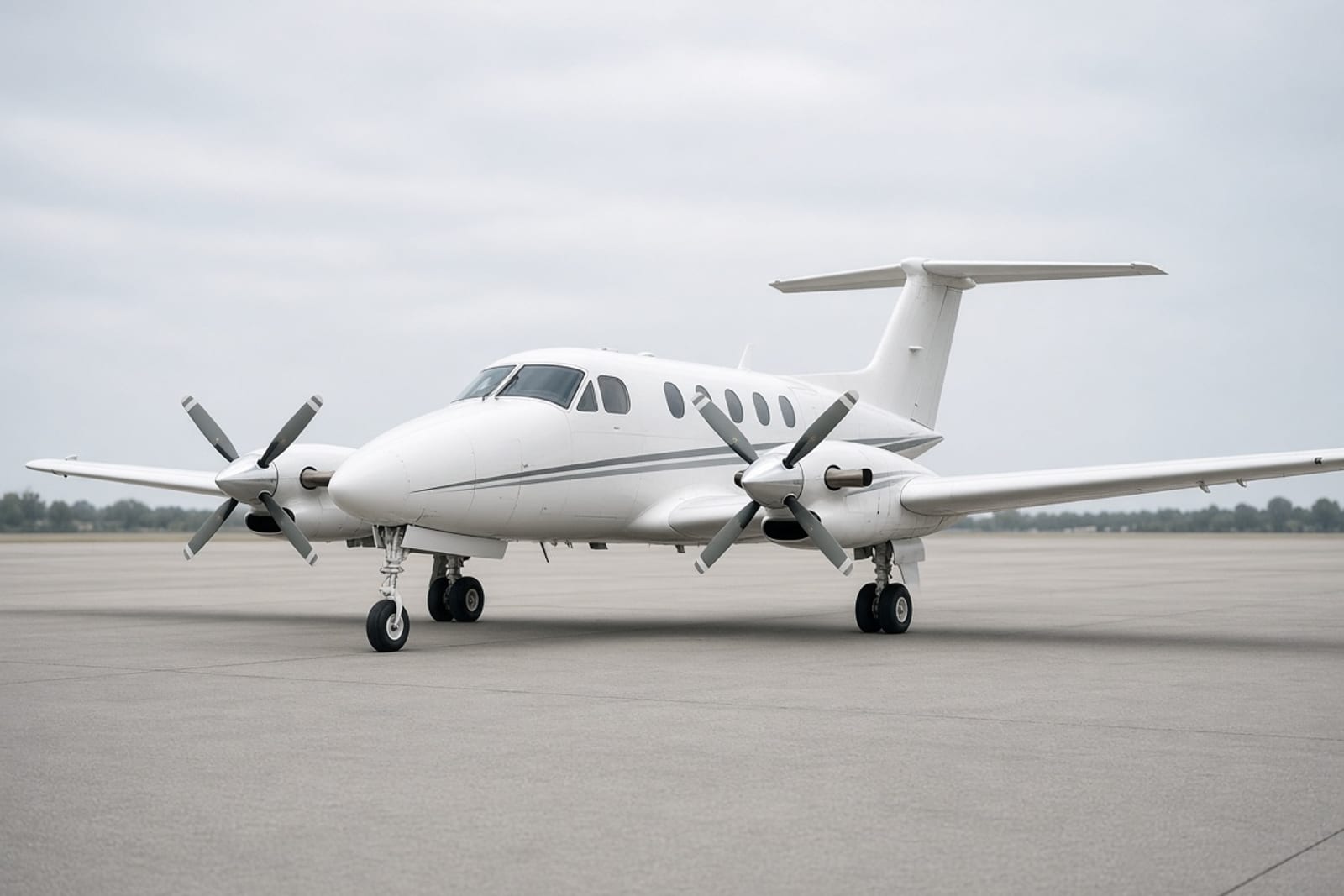
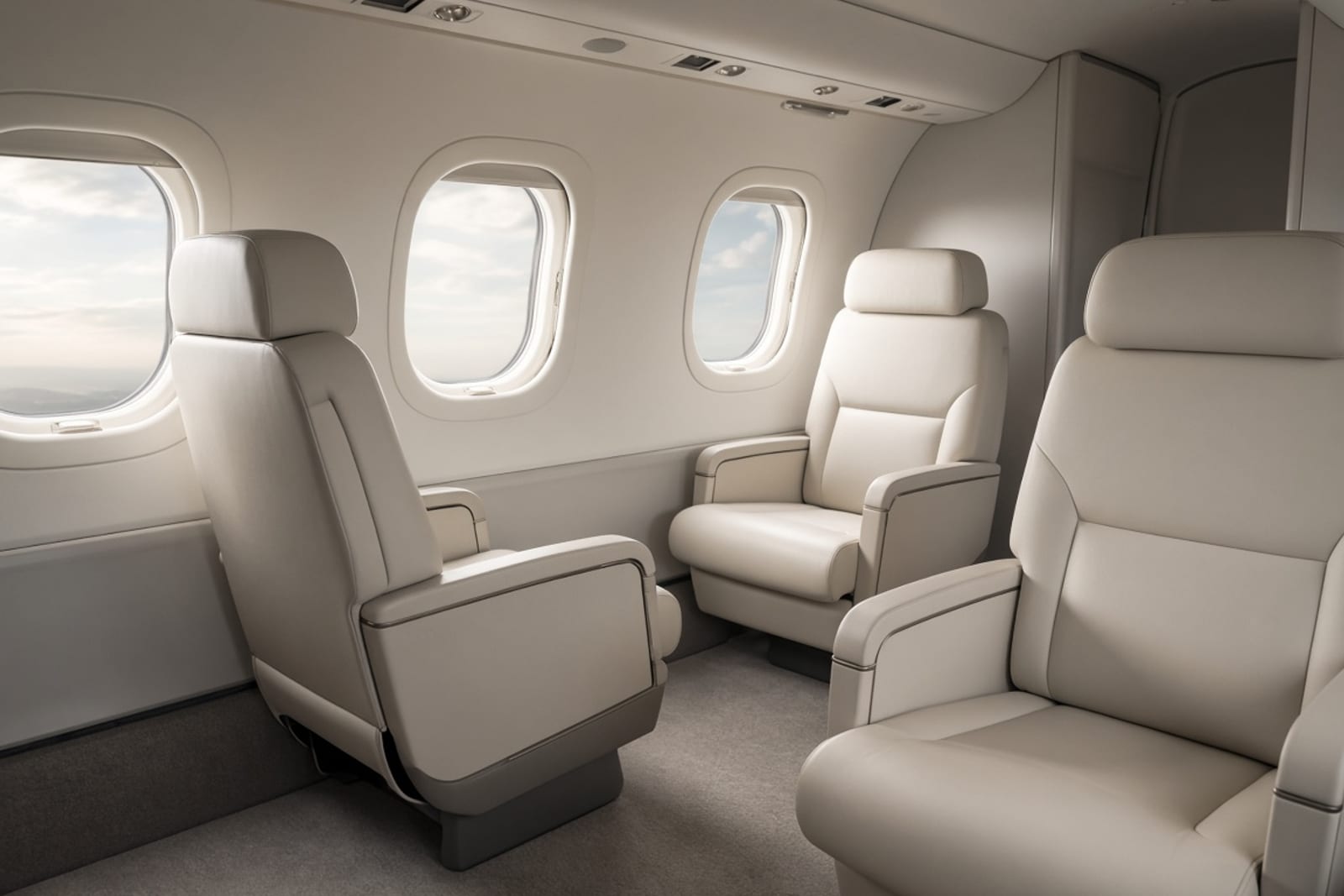
Popular turboprop models
| Model | Seats | Range | Good to know |
|---|---|---|---|
| Beechcraft King Air 360 | up to 11 occupants including crew (typically 6–8 passengers) | 1,806 nm | Twin-engine turboprop; Textron quotes the range for a ferry mission with NBAA IFR reserves, so a full cabin flies less far. |
| Beechcraft King Air 260 | up to 9 occupants including crew (typically 6–7 passengers) | 1,720 nm | Smaller King Air cabin with a published take-off distance short enough for many regional strips. |
| Pilatus PC-12 NGX | up to 9 passengers (typically 6 in executive layout) | 1,803 nm | Single-engine turboprop; Pilatus gives 1,803 nm with four passengers and 1,568 nm with six. |
When a turboprop is the right choice
Choose a turboprop when the flight is short, the group is small and cost matters more than speed. On a one-hour sector a turboprop is often only 15 to 25 minutes slower than a light jet, but its hourly rate is lower, and the daily minimum is one billable hour. On London to Paris, the RoutePass model gives about 1 hour 01 minute and roughly £2,500–£4,000 one way in a turboprop, against about 47 minutes and £4,000–£5,500 in a light jet.
The second reason is access. Turboprops can use runways from about 3,500 feet in our planning model, and many are certified for grass or gravel strips. That opens up island airfields, private estates and small regional airports that jets cannot use or can only use with weight limits. They are also well suited to safari lodges and bush strips in southern and eastern Africa, where the operator, not the broker, decides whether a given strip is approved for the aircraft.
A turboprop is the wrong choice for long sectors. The type cruises at roughly 270 knots block speed in our model, so a three-hour flight in a turboprop would take about two hours in a light jet, and time on board starts to cost more than the hourly saving.
Routes from London, Lagos, New York and Johannesburg
From London (Farnborough in our model), a turboprop flies non-stop to Paris Le Bourget in about 1 hour 01 minute (£2,500–£4,000 one way), to Edinburgh in about 1 hour 27 minutes (£3,500–£5,500) and to Geneva in about 1 hour 53 minutes (£5,000–£7,000). Nice is possible non-stop in about 2 hours 29 minutes (£6,500–£9,500), but a light jet does it in 1 hour 46 minutes for £7,000–£10,000, so most people switch to a jet at that distance. London to Mykonos needs a fuel stop in a turboprop.
From Lagos, turboprops cover the main domestic and West African links: Lagos to Abuja in about 1 hour 22 minutes (£3,500–£5,000), Lagos to Port Harcourt in about 1 hour 13 minutes (£3,000–£4,500) and Lagos to Accra in about 1 hour 08 minutes (£3,000–£4,500). In Nigeria, only operators holding a Nigeria Civil Aviation Authority (NCAA) Air Operator Certificate may fly charter, and only with aircraft listed on that certificate. Ask to see it; it is a real safety check, not paperwork.
From New York (Teterboro), a turboprop reaches Nantucket in about 1 hour 01 minute and Boston in about 55 minutes, each from about £2,500–£4,000 one way. US charter flights are operated by FAA Part 135 certificated carriers. From Johannesburg (Lanseria), Victoria Falls is about 2 hours 11 minutes (£5,500–£8,500) and Cape Town about 2 hours 57 minutes (£7,500–£11,000).
Cabin and runway trade-offs
Turboprop cabins are smaller than midsize jet cabins. The King Air and PC-12 have club seating and a usable aisle, but most adults cannot stand fully upright, and the toilet is a compact unit at the rear rather than a full washroom. Baggage space is reasonable for a short trip; golf bags and skis fit, but check sizes with the operator before you fly.
Turboprops usually cruise lower than jets, below about 30,000 feet, so they meet more weather and can feel bumpier. Cabin noise is higher, mostly from the propellers. On the other hand, they perform well from short and hot runways, which is why they are common across Africa. The published ranges above are best-case figures; with six passengers and bags, plan on the practical range of about 1,300 nm used in our pricing.
What drives a turboprop charter price
The main driver is flight time multiplied by the hourly rate, which runs from about £1,800 to £2,600 depending on the model, its age and the operator. One-way trips usually cost more per hour flown, because the aircraft has to return to base or position from elsewhere; the one-way prices above include an allowance for this. Airport, handling and passenger charges sit on top of the flying cost and are included in our estimates as a range.
Overnight stops can add crew accommodation and a daily minimum if the aircraft waits for you. Single-pilot aircraft such as the PC-12 can be cheaper to crew, though many charter operators fly them with two pilots. All figures here are indicative and are confirmed by the operator in a written quote.
Routes a turboprop flies non-stop
FABNCE
 LondonNice

London to Nice
FABIBZ
LondonIbiza
London to Ibiza
FABGVA
LondonGeneva
London to Geneva
FABLBG
LondonParisLondon to Paris
FABPMI
LondonPalmaLondon to Palma
FABLIN
LondonMilan
London to Milan
Turboprop questions
01How much does it cost to charter a turboprop?
Indicatively about £1,800–£2,600 per flight hour. In our model, London to Paris comes out at about £2,500–£4,000 one way and Lagos to Accra at about £3,000–£4,500.
02Is a turboprop safe?
Modern turboprops such as the King Air and PC-12 are widely used for charter, medical and government flying. Safety depends mostly on the operator, so we only work with licensed operators and you can ask to see their certificate.
03How many people fit in a turboprop?
Usually 6 to 8 passengers. The King Air 360 is certified for up to 11 occupants including crew, but charter layouts normally seat fewer people in more comfort.
04Can a turboprop fly from London to the south of France?
Yes. London to Nice is about 2 hours 29 minutes non-stop in a turboprop. A light jet saves about 40 minutes for a similar price, so many travellers choose a jet for that trip.
05How much luggage can a turboprop take?
It depends on the model. The PC-12 has a large rear cargo door that helps with bulky items, while other types carry less. Tell us your bags, skis or equipment when you ask for a quote, and we check with the operator that they fit with the passengers and fuel.
06Can a turboprop use small airports?
Yes. Turboprops can use shorter runways than most jets, which opens up smaller regional airfields and island airstrips closer to where you are going. The operator checks the runway length, surface and weather limits for the aircraft before it confirms the flight.
07What documents do I need for a turboprop flight?
For international trips every passenger needs a valid passport and any visa or travel authorisation the destination requires, such as a UK ETA for most visitors arriving in Britain. For domestic flights the operator tells you which photo ID it accepts. Send passenger details when you book.
Keep reading
Prices by country
Guides
Tell us where you are going
Send your trip and get a confirmed quote from vetted operators on WhatsApp.