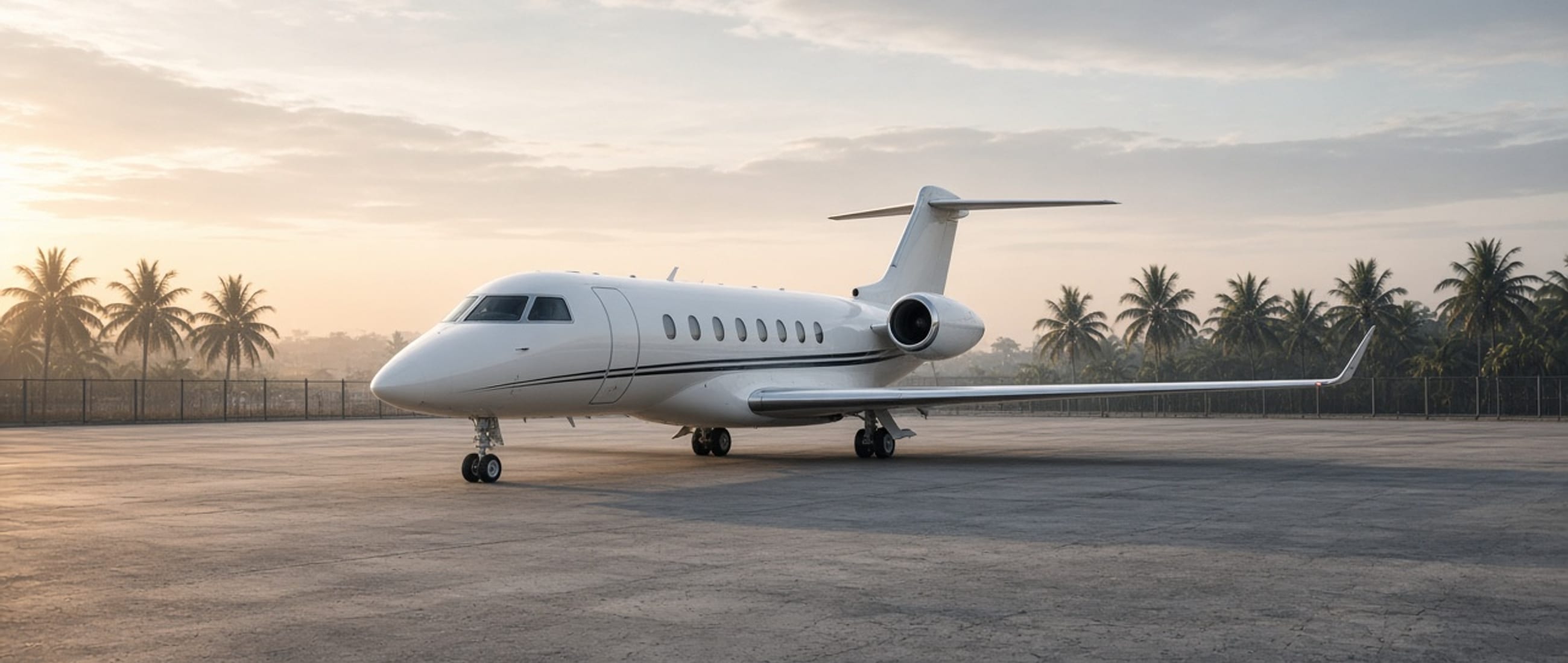
Who can legally fly a private jet charter in Nigeria
Charter in Nigeria is commercial air transport, so it is regulated in the same way as an airline. The operator must hold an NCAA Air Operator Certificate (AOC) for non-scheduled operations, and the aircraft must be named in the operations specifications (OpSpecs) attached to that certificate. In April 2024 the NCAA's then acting Director General, Chris Najomo, put it plainly: only aircraft listed in the OpSpecs of an AOC are authorised for charter services (reported by ch-aviation, 23 April 2024).
Many private jets in Nigeria are not on any AOC. They fly under a Permit for Non-Commercial Flight (PNCF), which lets a company or individual use its own aircraft for its own purposes. A PNCF aircraft may not be hired out or have seats sold on it. Part 18.3.4 of the Nigeria Civil Aviation Regulations 2023 prohibits commercial use of these aircraft, and the NCAA has said publicly that engaging a PNCF holder for a commercial flight is illegal.
This matters to passengers for practical reasons, not just legal ones. An AOC holder is audited by the NCAA on crew training, maintenance and operating procedures. An illegal flight may not be covered by the aircraft's insurance, and an aircraft caught flying commercially on a PNCF can be stopped on the day you travel.
Grey charter and the 2024 enforcement
Grey charter is the industry term for a flight sold to paying passengers by someone who is not allowed to sell it: usually a PNCF aircraft offered for hire through an intermediary. It can look cheaper because the seller avoids the cost of holding an AOC. The Nigerian authorities acted against it repeatedly in 2024.
- March 2024: the NCAA warned PNCF holders against using their aircraft commercially.
- April 2024: after inspectors were deployed to general aviation terminals and the private wings of airports, the NCAA suspended the PNCFs of three operators found breaking the rules, and ordered all PNCF holders to be re-evaluated by 19 April 2024 (ch-aviation; BusinessDay).
- 27 June 2024: the Minister of Aviation and Aerospace Development, Festus Keyamo, inaugurated a Ministerial Task Force on Illegal Private Charter Operations and Related Matters (Nairametrics; Federal Ministry of Information).
- 5 July 2024: the NCAA suspended the PNCFs of ten private jet operators that had not complied with the recertification directive (Nairametrics; ch-aviation).
How to check an operator before you pay
Checking takes minutes and is worth doing every time, including when a friend recommends the aircraft. The NCAA announces new AOC grants on its website at ncaa.gov.ng, and you can contact the authority directly to confirm that a certificate is current. We did not find a single downloadable register of charter operators on the NCAA site, so treat the documents below as the main check.
- Ask for a copy of the operator's AOC and check the company name matches the name on your contract and invoice.
- Ask for the operations specifications and find the aircraft's registration (Nigerian aircraft are registered 5N-) on the list. If the registration is not there, that aircraft may not be used for your charter.
- Check the AOC's expiry date. Nigerian regulations set a maximum validity for non-scheduled AOCs, so an old copy proves little.
- For a foreign-registered aircraft, ask for its own operator's AOC from its home regulator and confirm that the flight permits for Nigeria are in place.
- Be wary of any offer where the seller cannot name the operator, or where the price is far below the ranges on our Nigeria price page.
Private terminals in Lagos and Abuja
In Lagos, private flights use the general aviation side of Murtala Muhammed International Airport (LOS), which has a 12,794 ft runway. ExecuJet's Lagos FBO, now part of Luxaviation, lists customs and immigration facilities, apron parking with direct access to the main runway and taxiway, and a hangar of about 4,700 square metres, large enough for a Boeing Business Jet. Evergreen Apple Nigeria (EAN) opened a purpose-built business aviation terminal at the airport in 2011. Which facility you use depends on the operator's handling arrangement, and it should be named on your itinerary.
In Abuja, Nnamdi Azikiwe International Airport (ABV) has an 11,842 ft runway and a general aviation terminal used by private and non-scheduled flights, with several ground handling companies. The operator books handling at both ends. Domestic flights between Lagos and Abuja involve security screening and identity checks but no immigration or customs; international departures clear both at the FBO or terminal.
Popular domestic and international routes, with indicative prices
Domestic trips are short. Lagos to Abuja (276 nm) costs from about $4,400–$6,400 (£3,500–£5,000) one way in a turboprop, taking about 1 hour 22 minutes, or $5,100–$7,000 (£4,000–£5,500) in a light jet in about an hour. Lagos to Port Harcourt (236 nm) is from about $3,800–$5,700 (£3,000–£4,500) in a turboprop or $5,100–$7,000 (£4,000–£5,500) in a light jet, with jets taking under an hour.
Lagos to Accra is the shortest international hop: about 52 minutes in a light jet, from about $5,100–$7,000 (£4,000–£5,500), but it needs Ghanaian landing permits and immigration at both ends. Lagos to London is from about $57,200–$83,200 (£45,000–£65,500) in a super-midsize jet flying non-stop in about 6 hours 27 minutes, or $78,700–$116,800 (£62,000–£92,000) in a heavy jet. Lagos to Dubai needs a heavy jet to fly non-stop, from about $92,100–$136,500 (£72,500–£107,500) in about 7 hours 23 minutes; a super-midsize jet with one fuel stop costs about $73,700–$107,300 (£58,000–£84,500).
These are indicative one-way ranges from the RoutePass pricing model, not fixed fares. For hourly rates and naira estimates across every aircraft size, see our Nigeria price page.
Paying in US dollars or naira
International charters to and from Nigeria are usually quoted and invoiced in US dollars, because fuel, permits, handling abroad and often the aircraft itself are paid for in dollars. Domestic pricing is more complicated. The Central Bank of Nigeria has long required domestic goods and services to be priced in naira, and in February 2024 it restated a ban on foreign-currency pricing of domestic transactions. Law-firm summaries of the CBN's 2026 foreign exchange manual say exemptions remain for specified aviation activities, so the rules depend on the transaction.
In practice, ask three things before you sign: which currency the contract is in, which exchange rate applies if you pay in another currency, and when that rate is fixed. As a rough guide, the light-jet Lagos to Abuja range of $5,100–$7,000 is about ₦7 million to ₦9.7 million at roughly ₦1,380 to US$1 (Wise mid-market rate, 9 November 2026). The naira figure is approximate and will move with the exchange rate.
Ground transport and security
The flight is often the simplest part of the day; the road to and from the airport needs as much planning. The UK Foreign, Commonwealth and Development Office (FCDO) advises that criminals posing as airport greeters are a problem at Nigeria's international airports, so make sure any driver identifies themselves before you set off. It also advises limiting travel after dark outside city centres, avoiding quiet and poorly lit roads, and using hotel cars with drivers where possible rather than taxis.
For Lagos, the FCDO advises caution particularly on the mainland, where Murtala Muhammed airport is, and Lagos traffic between Ikeja and Victoria Island, Ikoyi or Lekki is unpredictable, so allow generous time. The FCDO currently advises against all but essential travel to the non-riverine areas of Rivers State, which includes Port Harcourt; check how this affects your travel insurance before booking that route. Tell the operator in advance if you are arranging close protection or a specific vehicle, so that the handler can plan airside access.