Wilson or JKIA: choosing a Nairobi airport for private jet charter in Kenya
Wilson Airport (WIL), a few kilometres south of the city centre, is East Africa's busiest general aviation airport and the base for most of Kenya's safari airlines and charter operators. Its runway is 5,052 ft, which suits turboprops and light jets but limits larger aircraft. In 2026 the main runway was rehabilitated: Business Daily reported in August 2026 that it reopened on 29 July for daytime flights (06:30 to 18:30), with night operations waiting for KCAA approval of the runway lights. Ask the operator about current hours if you need an early or late departure.
Jomo Kenyatta International Airport (NBO), east of the city, has a 13,507 ft runway and is the airport for heavy and long-range jets and most long-haul private flights, including Nairobi to London. It is also convenient if you are connecting from an international airline flight. If your group is small and the trip starts with a safari or coast flight, Wilson is usually the simpler choice, because the aircraft is often based there and no positioning flight is needed.
Maasai Mara airstrips and the aircraft that use them
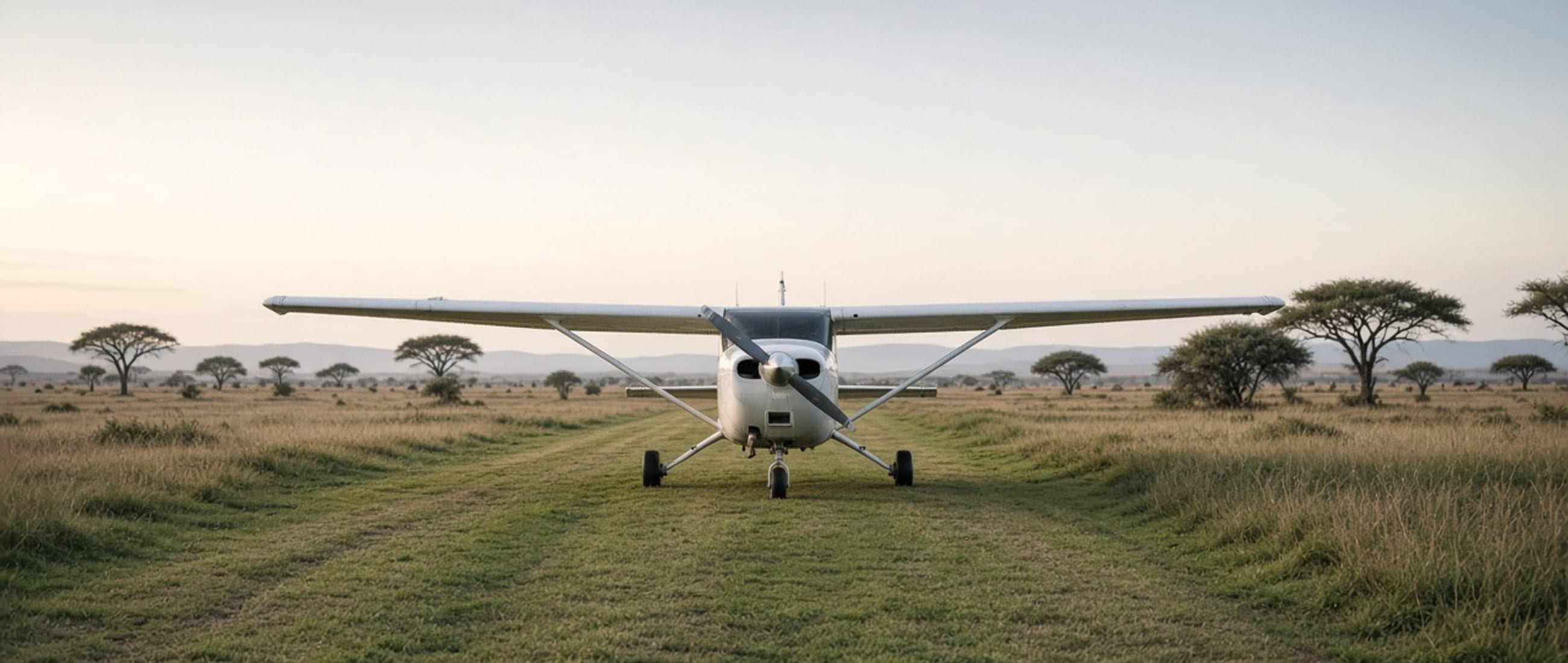
The Maasai Mara National Reserve and its conservancies are served by many small airstrips, including Keekorok, Olkiombo and Musiara. Most are unpaved gravel or dirt strips, and their length and surface rule out most jets. That is why safari flying is done by turboprops such as the Cessna 208 Caravan, which Kenyan safari airlines such as Safarilink fly in a 12-seat layout from Wilson, alongside larger Dash 8 aircraft on busier scheduled routes.
You can join a scheduled safari flight, which stops at several airstrips, or charter a whole aircraft that flies directly to the strip nearest your camp at a time you choose. A private charter makes most sense for families or groups, for tight connections, or for camps a scheduled flight does not serve on your day. Turboprop charter costs about $2,300–$3,300 (£1,800–£2,600) per flight hour in our pricing model; the operator will quote the exact flying time to your airstrip.
Luggage limits on light aircraft
Light aircraft have small, irregularly shaped holds and strict weight limits, and bush airstrips can add performance limits on hot days. On scheduled safari flights the limits are published and enforced. Safarilink, for example, sets 15 kg per person, including hand baggage, in soft bags, with 20 kg on routes such as Mombasa, Diani and Zanzibar. Rigid suitcases may be sent on a later flight.
On a private charter, the limit depends on the aircraft, the number of passengers, the fuel needed and the airstrip, so it is worked out for your flight rather than fixed. Give the operator the total weight of bags and passengers in advance, use soft bags, and mention cameras with long lenses, golf bags or kitesurfing equipment. If you need more space, a larger turboprop or an extra seat costs less than having bags left behind.
Crossing into Tanzania: Serengeti, Kilimanjaro and Zanzibar
A flight from Kenya into Tanzania is international, so passengers clear Kenyan exit formalities at an airport with customs and immigration, such as Wilson, before leaving. On the Tanzanian side, the aircraft must land first at an airport where it can clear Tanzanian customs and immigration. Kilimanjaro International and Arusha both have these facilities and are common stops before continuing to Serengeti airstrips, but the operator will confirm which port of entry it is using. The operator also needs a permit from the Tanzania Civil Aviation Authority, so allow several working days.
British visitors need a Tanzanian visa, which can be applied for online as an e-visa before travel. All non-resident visitors to mainland Tanzania and Zanzibar must also hold Tanzanian government inbound travel insurance, valid for up to 92 days. It is bought from the Zanzibar Insurance Corporation if Zanzibar is your first port of entry, or from the National Insurance Corporation if you enter on the mainland, and your own travel insurance does not replace it. Check whether you need a yellow fever certificate for the countries on your itinerary.
Nairobi to Zanzibar (328 nm) costs from about $5,100–$7,600 (£4,000–£6,000) in a turboprop, taking about 1 hour 34 minutes, or $5,700–$8,300 (£4,500–£6,500) in a light jet in about 1 hour 10 minutes.
The Kenyan coast: Mombasa and Diani
Nairobi to Mombasa (233 nm) is the most common domestic private trip. It costs from about $3,800–$5,700 (£3,000–£4,500) one way in a turboprop, taking about 1 hour 12 minutes, or $5,100–$7,000 (£4,000–£5,500) in a light jet in about 55 minutes. Moi International Airport has a 10,991 ft runway and suits any aircraft that can use Wilson.
For Diani Beach, south of Mombasa, Ukunda airstrip saves the road journey and the Likoni ferry crossing. It is managed by the Kenya Airports Authority and has a short tarmac runway of about 1,200 metres, which suits turboprops; ask the operator whether a jet can use it with your load. As a domestic flight, there is no immigration check, but carry identification.
Licensing, insurance and longer routes
Commercial flights in Kenya must be operated by companies holding an Air Operator Certificate from the Kenya Civil Aviation Authority (KCAA) and an air service licence under the Civil Aviation (Licensing of Air Services) Regulations. Foreign operators flying non-scheduled services into Kenya need an air service licence and a Foreign Air Operator Certificate. Ask for these documents and the aircraft registration before you pay. Kenyan aircraft are registered 5Y-.
Since 5 October 2026, most visitors staying in Kenya for under 12 months need Kenyan government travel health insurance, bought with the Electronic Travel Authorisation (eTA) or through the eCitizen portal. Citizens of East African Community states are exempt. British visitors need an eTA and are advised to apply at least two weeks before travel.
For longer trips, Nairobi to Kigali costs from about $7,000–$9,500 (£5,500–£7,500) in a light jet, taking about 1 hour 22 minutes, or $6,400–$8,900 (£5,000–£7,000) in a turboprop. Nairobi to London non-stop needs an ultra-long-range jet from Jomo Kenyatta, from about $153,700–$228,000 (£121,000–£179,500) in about 8 hours 13 minutes; a super-midsize jet with one fuel stop costs about $84,500–$122,600 (£66,500–£96,500). In shillings, the Mombasa turboprop range is roughly KSh494,000–KSh741,000 at about KSh130 to US$1 (Wise mid-market rate, 9 November 2026, approximate). For hourly rates in shillings, see our Kenya price page.